
Germany is famous for engineering, precision and efficiency. It is also famous for paperwork.
If you are thinking about starting a business in Germany in 2026, that combination can sound a little intimidating. You may have heard stories about tax forms, appointments, registration offices and letters arriving in German that seem to require a second letter just to explain the first one.
But don’t let the bureaucracy put you off.
Starting a business in Germany is very achievable when you understand the process before you begin. Whether you want to work as a freelancer, open a small local business, launch an online company, build an agency or create a larger company with employees, the important thing is getting the foundation right.
The process is not usually one huge application. Instead, you work through several steps: decide what you will do, choose the right legal structure, register the business where required, deal with the tax office, arrange your finances and make sure you have the licenses and insurance your particular activity requires.
This guide explains how to start a business in Germany in 2026 in straightforward language.
Why Start a Business in Germany in 2026?
Germany remains one of Europe’s most important business markets. It has a large domestic economy, strong infrastructure, an established industrial base and access to the wider European Union market.
That creates opportunities for very different types of entrepreneurs.
You might be a software developer selling services to international clients. You might want to open a restaurant, build an e-commerce brand, start a consulting company or provide professional services. Germany’s business environment can support all of these, although the registration and licensing requirements will differ.
The bigger question is not simply whether Germany is a good place to start a business.
It is whether Germany is the right place for your particular business model.
If your customers, suppliers, employees or partners are based in Germany or elsewhere in Europe, establishing a business there can make practical sense. For international founders, however, immigration status, taxation and the right to conduct self-employed work need to be considered before launching.
What Do You Need to Start a Business in Germany?
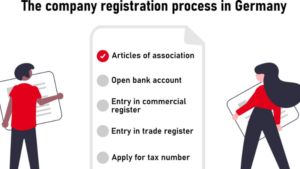
You will generally want to have:
- A clear business idea
- A defined business activity
- A business name
- A German business address where required
- The appropriate legal structure
- Identification documents
- A business plan or financial forecast
- Information about expected revenue and expenses
- A plan for taxes and bookkeeping
- Any industry-specific licenses or permits
- A business bank or payment account
- Appropriate insurance
- The necessary residence or self-employment permission if you are an international entrepreneur
Step 1: Decide What Your Business Will Actually Do
Start with the business, not the paperwork.
Before registering anything, write down exactly what you intend to sell and who will pay you.
For example, there is a big difference between:
- A freelance graphic designer
- An online retailer
- A construction company
- A marketing agency
- A restaurant
- A software company
- A financial consultancy
This distinction matters because your business activity can affect registration, taxation, professional permissions, insurance and industry regulations.
A useful starting point is to answer five simple questions:
- What am I selling?
- Who is my customer?
- Where will my customers be located?
- How will customers pay me?
- How much will it cost to operate the business?
You do not need a 50-page business plan to get started. But you should understand how the business is expected to make money.
Step 2: Decide Whether You Are a Freelancer or a Trade Business
This is one of the most important distinctions in Germany.
Some independent professionals can qualify as Freiberufler, while other activities are treated as commercial businesses or Gewerbe.
Freelance professions can include certain professional, scientific, artistic and consulting activities, although whether a particular occupation qualifies depends on the circumstances.
If you operate a commercial business, you will generally need to register the trade with the local Gewerbeamt. The German federal portal states that a Gewerbeanmeldung is required when starting a qualifying fixed commercial business, and the registration can generally be handled in person, by post or electronically, depending on the local authority.
Freelancers normally do not follow the same Gewerbe registration route.
This is why it is worth determining your classification early. Choosing the wrong path can create unnecessary administrative work later.
Step 3: Choose Your Business Structure
Germany offers several ways to structure a business.
Best options for smaller entrepreneurs include:
| Business structure | Often suitable for | Main consideration |
| Freiberufler | Certain independent professionals | Eligibility depends on the profession |
| Einzelunternehmen | Solo entrepreneurs and small businesses | Simple setup, but personal liability can apply |
| UG (haftungsbeschränkt) | Founders seeking limited liability with lower starting capital | More formal administration |
| GmbH | Established businesses and companies planning to grow | Higher formation and capital requirements |
| Partnership structures | Businesses founded by two or more people | Rules depend on the specific structure |
Einzelunternehmen
A sole proprietorship can be attractive if you are starting alone and want to keep the setup relatively straightforward.
The downside is that the business and owner are not separated in the same way as they are with a limited-liability company.
UG (haftungsbeschränkt)
The UG is often considered the lower-capital alternative to a GmbH.
A UG may be established under German company law with share capital less than the statutory minimum required by the GmbH.
GmbH
The GmbH is one of Germany’s best-known limited-liability company structures.
The statutory minimum share capital is €25,000. For registration, the law generally requires that at least half of the minimum share capital has been contributed in cash or qualifying contributions before registration.
That does not mean every new entrepreneur needs €25,000 sitting in a bank account before doing anything. It means you need to understand the capital and formation requirements before choosing a GmbH.
Step 4: Choose a Business Name
Your business name is more than something you put on an invoice.
It becomes part of your identity, so choose something that is easy to remember and appropriate for your market.
Before committing to a name:
- Check whether it is already being used.
- Check the commercial register where relevant.
- Check domain availability.
- Search for potentially conflicting trademarks.
- Make sure the name works in the German market.
- Avoid choosing a name simply because the domain is available.
If you are forming a company such as a GmbH or UG, the name also needs to meet German company-law requirements.
It is much easier to change a name before launching than after you have printed invoices, built a website and signed contracts.
Step 5: Register Your Business
If your activity qualifies as a Gewerbe, you generally register it with the local Gewerbeamt.
The federal government explains that the trade registration should generally be made when the business begins operating. Depending on the local authority, registration can be completed personally, electronically or through other accepted channels.
The registration information can then be passed to other relevant authorities, including the tax office and, where applicable, chambers or the commercial register.
What about freelancers?
If your work qualifies as a Freiberufler activity, you generally do not register it as a Gewerbe. Instead, the tax registration process with the Finanzamt becomes particularly important.
What about a GmbH or UG?
A GmbH or UG involves additional formation steps.
- Preparing the articles of association
- Notarial certification
- Establishing the required share capital
- Opening the appropriate account for the formation process
- Applying for commercial-register entry
- Completing tax registration
Step 6: Register With the Finanzamt
This is the part many first-time entrepreneurs underestimate.
Starting a business means dealing with the German tax system from the beginning.
You need to provide the tax authorities with information about your business so they can determine how it should be treated for tax purposes.
The Fragebogen zur steuerlichen Erfassung is used to provide information about the business or self-employed activity. The federal portal says that this questionnaire is generally submitted electronically through ELSTER, and the tax office subsequently provides the relevant tax number.
You may need to provide information such as:
- Your business activity
- Expected turnover
- Expected profit
- Banking information
- VAT-related information
- Your accounting method
- Business address
- Ownership details
Take this form seriously.
Your estimates can influence how the tax office handles your business, so it is worth getting professional help if you are unsure what to enter.
Step 7: Understand VAT and Other Taxes
Taxes are not something to think about after your first year.
They should be part of your business plan from day one.
Depending on your business structure and activities, you may encounter:
- Personal income tax
- Corporate income tax
- Trade tax
- Value-added tax (VAT)
- Payroll-related taxes
- Social security obligations
VAT is especially important if you sell goods or services.
You need to understand whether VAT applies to what you sell, whether you need to charge it, how invoices should display it and how VAT works when dealing with customers in other EU countries.
Step 8: Check Licenses and Permits
Not every German business needs a special professional license.
But some absolutely do.
Your requirements depend on what you are doing.
For example, businesses in areas such as:
- Food and hospitality
- Construction
- Transport
- Financial services
- Healthcare
- Security
- Certain skilled trades
- Regulated professions
may face additional requirements.
Do not assume that registering a business automatically gives you permission to perform every activity associated with it.
Before opening your doors or accepting customers, check the rules that apply specifically to your industry and municipality.
Step 9: Open a Business Bank Account
Once your legal and tax setup is underway, establish a clean financial system.
For a company, separating business and personal finances is essential for good bookkeeping.
Even where a separate account is not strictly mandatory for every form of self-employment, it is a sensible business practice.
A dedicated business account can make it easier to:
- Track revenue
- Pay suppliers
- Manage expenses
- Reconcile invoices
- Prepare tax returns
- Work with an accountant
- Understand your actual cash flow
If you have international customers, you should also think about currencies and payment methods.
A freelancer who earns €5,000 from German clients has different banking needs from an agency receiving USD, GBP and EUR from customers around the world.
Step 10: Set Up Accounting From Day One
One of the easiest mistakes for a new business owner is treating bookkeeping as a problem for “later.”
Later usually arrives with a large pile of receipts.
Instead, establish a simple system immediately.
Keep records of:
- Sales invoices
- Purchase invoices
- Business expenses
- Bank transactions
- Receipts
- Contracts
- Tax documents
- Employee-related records, if applicable
You may also want accounting software that connects with your business account.
If your business involves international transactions, multiple currencies or employees, consider working with a Steuerberater.
A good tax adviser can cost money, but fixing an avoidable tax or bookkeeping mistake can cost considerably more.
Step 11: Arrange Business Insurance
Insurance is another area where there is no single answer for every entrepreneur.
The appropriate coverage depends on your profession and level of risk.
Depending on the business, you might consider:
- Professional liability insurance
- Business liability insurance
- Cyber insurance
- Property insurance
- Equipment insurance
- Employee-related coverage
Some industries have specific insurance expectations or statutory requirements.
Think about what could realistically go wrong in your business and what financial damage that event could create.
Step 12: If You Are an Expat, Check Your Right to Work
If you are not an EU/EEA or Swiss citizen, do not assume that living in Germany automatically gives you the right to become self-employed.
Your residence status can determine whether you are permitted to operate a business or work independently.
You may need an appropriate residence permit or authorization for self-employment.
This should be addressed before you build your business around an assumption that your immigration status allows you to operate it.
For international founders, immigration planning is just as important as business registration.
How Much Does It Cost to Start a Business in Germany?
There is no single startup price.
A freelancer working from home may have relatively low initial administrative costs. A GmbH with professional advisers, notarial work, commercial-register expenses, office space and employees can require substantially more capital.
A simplified comparison looks like this:
| Business type | General setup cost | What affects the cost |
| Freelancer | Often relatively low | Profession, tax advice and equipment |
| Sole proprietorship | Relatively low | Local registration and business needs |
| UG | Several hundred euros or more in practical formation costs | Notary, registration, advice and capital |
| GmbH | Significantly higher | €25,000 statutory share capital plus formation and operating costs |
The GmbH’s €25,000 minimum share capital is established by German company law.
Your real startup budget should also include things such as:
- Website
- Software
- Equipment
- Insurance
- Accounting
- Marketing
- Office or workspace
- Professional advice
- Employee costs
- Initial inventory
- Taxes
- Working capital
The registration fee is rarely the largest expense in building a real business.
What Are the Biggest Challenges of Starting a Business in Germany?
Germany’s bureaucracy is probably the challenge you hear about most.
And yes, it can be complicated.
But bureaucracy is not the only issue.
- Understanding the German tax system
- Language barriers
- Finding the right business structure
- Managing cash flow
- Administrative workload
How to Receive International Business Payments in Germany
International payments are increasingly important for German freelancers, agencies and online businesses.
A company might receive:
- EUR from German customers
- USD from American clients
- GBP from British customers
- CHF from Swiss customers
This is where traditional banking can sometimes become inconvenient.
International transfers may involve conversion costs, transfer fees or additional banking steps.
A multi-currency business account can therefore be useful for businesses that regularly work across borders.
Conclusion
Starting a business in Germany in 2026 does involve paperwork, but the process becomes much less intimidating when you break it into manageable steps.
First, get clear about what you want to sell. Then determine whether you are a freelancer or running a commercial business, choose the right legal structure and complete the necessary registrations. From there, deal with taxes, bookkeeping, banking, insurance and any industry-specific requirements.
The biggest mistake is trying to rush through everything simply to say, “My business is registered.”
Registration is only the beginning.
A successful German business needs a sensible financial plan, reliable bookkeeping, appropriate insurance, a way to get paid and a clear understanding of its customers. If you are building an international business, you also need to think carefully about currencies and cross-border payments.
Germany may have a reputation for paperwork, but there is another side to that system: once you understand what is required, you can build on a fairly structured foundation.
FAQs
How much money do I need to start a business in Germany?
There is no universal amount. A freelancer can potentially start with a relatively small budget, while a GmbH requires statutory share capital of €25,000. Your actual budget should also account for equipment, insurance, accounting, marketing, taxes and working capital.
Can I start a business in Germany as a freelancer?
Yes, if your activity qualifies as a freelance profession under German rules. Freiberufler generally follow a different registration route from commercial businesses and typically deal directly with the Finanzamt for tax registration.
Do I need to register a Gewerbe in Germany?
If your activity is a qualifying commercial business, generally yes. The German federal portal states that a Gewerbeanmeldung is required when starting a qualifying trade business.
Do I need a German business bank account?
Not every entrepreneur has exactly the same banking requirements, but keeping business finances separate from personal finances is strongly recommended. It makes bookkeeping, tax preparation and cash-flow management much easier.
Do I need an accountant in Germany?
You can manage some small businesses yourself, but professional tax advice can be particularly valuable when your business involves VAT, employees, a company structure or international transactions.
Is Germany a good country for starting a business in 2026?
Germany can be a strong option for entrepreneurs who have a clear market, realistic finances and a business model that fits the country’s regulatory environment. It is particularly attractive for businesses connected to Germany’s large domestic and European markets, but founders should factor in taxation, administration and operating costs before deciding.
Can I run a German business and work with international clients?
Yes. Many German businesses work with customers, suppliers and contractors internationally. However, international transactions can introduce additional VAT, tax, currency and invoicing considerations, so these should be planned rather than handled after the business starts receiving foreign payments.