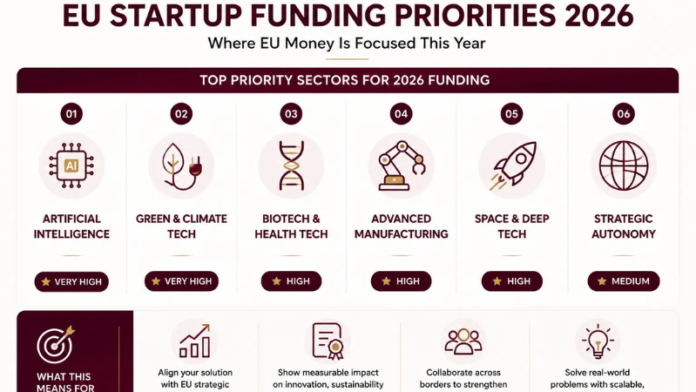
Starting a company in Europe in 2026 can feel like a strange mix of opportunity and uncertainty. Although there is a lot of money available, it is frequently more difficult to obtain the correct funding and determine whether you truly qualify for it than it is to develop the initial version of the product.
The good news is that European founders have more options than traditional bank loans or venture capital. Startup grants in Europe can help fund research, product development, technology validation, hiring, internationalisation, and commercialisation without requiring founders to give away equity.
But there is an important catch: grants are not free money with a simple application form. Most programmes have specific eligibility rules, technical requirements, deadlines, and reporting obligations.
So, which European startup grants are worth looking at in 2026?
Here are some of the strongest options to consider.
1. EIC Accelerator
If you are building a genuinely innovative, high-growth startup, the EIC Accelerator is one of the most important European funding programmes to investigate.
It is designed for startups and SMEs developing innovations with the potential to create or disrupt markets. In 2026, the programme offers a grant component of up to €2.5 million, alongside an investment component of up to €10 million.
The programme is particularly attractive for deep-tech companies that may struggle to raise conventional venture capital because of the technical and commercial risks involved.
The 2026 EIC Accelerator has a total budget of €634 million, including €414 million for the Open programme and €220 million for specific Challenges.
Best for: Deep tech, biotech, climate tech, advanced materials, AI and other breakthrough technologies.
Funding: Grant below €2.5 million, plus potential equity investment.
2. EIC Accelerator Challenges
Some startups have a better chance through a targeted EIC Challenge rather than the open call.
The 2026 Challenges have a combined budget of €220 million and focus on areas where Europe wants breakthrough technologies to make a real-world impact. Topics include advanced materials for renewable energy and storage, fusion technologies, agricultural soil regeneration, critical raw materials and climate adaptation.
The advantage here is alignment. If your startup already solves a problem highlighted by the programme, you can build your application around a clearly defined European priority.
Best for: Startups whose technology directly matches one of the 2026 Challenge topics.
3. EIC Pathfinder
Not every startup is ready to commercialise.
If you are still working on an ambitious technology at an early research stage, EIC Pathfinder may be more appropriate.
The programme supports high-risk, high-gain research with the potential to create future technologies. Pathfinder grants can reach €4 million or more when duly justified.
This is less about having a polished startup with immediate revenue and more about proving that a potentially transformative technology can work.
Best for: Early-stage deep-tech research and breakthrough technology projects.
4. EIC Transition
There is a difficult stage between “the research works” and “customers will pay for it.”
That is where EIC Transition comes in.
The programme is intended to help turn research results into genuine innovation opportunities and prepare technologies for market entry. In 2026, it has a €100 million budget, with grants of up to €2.5 million.
For a university spinout or research-heavy startup, this can be a valuable bridge between laboratory success and commercialisation.
Best for: Research spinouts and startups turning validated research into commercial products.
5. EIC Pre-Accelerator
Early-stage deep-tech founders in Europe’s widening countries should also look at the EIC Pre-Accelerator.
The programme is designed to improve technology, business and investment readiness before companies pursue larger funding.
Eligible companies can receive substantial grant support and business acceleration services, although the specific funding terms vary by call. The programme focuses on startups in designated widening countries, including countries such as Poland, Portugal, Romania, Greece, Croatia and others.
The important point is that this is not simply about paying bills. The programme is designed to help promising companies become ready for larger investment.
Best for: Early-stage deep-tech startups in eligible widening countries.
6. Eurostars
If your startup needs international partners to develop a new product or technology, Eurostars deserves attention.
Eurostars supports collaborative, market-oriented R&D projects involving innovative SMEs and international partners. Projects can involve companies, universities and research organisations.
This makes it particularly interesting for founders whose product cannot be developed effectively in isolation.
For example, a European health-tech startup could potentially work with a research organisation and another technology company in a different participating country.
Best for: Innovative SMEs conducting international R&D projects.
7. Digital Europe Programme
The Digital Europe Programme is another source of funding for digital technology businesses that should be kept an eye on.
Rather than focusing exclusively on traditional startup grants, the programme supports the wider adoption and development of digital technologies across Europe.
Current 2026 opportunities include calls related to AI and data and advanced digital skills.
This can be particularly relevant to companies working around artificial intelligence, data infrastructure, cybersecurity, digital skills and other strategic digital technologies.
Best for: Digital and AI-focused companies participating in eligible projects or consortia.
8. EIC STEP Scale Up
This one is slightly different.
EIC STEP Scale Up is not a traditional startup grant. It is aimed at companies that are already beyond the earliest startup stage and need substantial capital to scale.
In 2026, the programme has a €300 million budget and can provide equity investments of €10 million to €30 million per company. The goal is to help companies attract much larger private investment rounds.
So, if your company already has significant traction and is preparing for a major scale-up, this is worth investigating.
Best for: High-growth strategic technology companies preparing for large funding rounds.
9. National Startup Grants
European Union programmes get most of the attention, but founders shouldn’t overlook national and regional grants.
Countries across Europe operate their own funding schemes for startups, SMEs, innovation, green technology, digitalisation and job creation.
The advantage is that these programmes can sometimes be more closely aligned with local business conditions than EU-wide schemes.
A founder in Germany, France, Spain, Italy, Portugal or another European market should therefore check both EU-level opportunities and the funding programmes offered by their national or regional innovation agencies.
Best for: Startups whose projects have strong national or regional economic impact.
10. Regional and Innovation Grants
There is another layer of funding that is easy to miss: regional programmes.
European regions often use public funding to encourage entrepreneurship, research, sustainability, digital transformation and employment.
These grants may be smaller than the EIC programmes, but that does not necessarily make them less useful.
For an early-stage founder, a €50,000 or €100,000 regional grant can sometimes be more practical than applying for a multimillion-euro programme designed for advanced deep-tech companies.
Best for: Early-stage businesses, local innovation projects and startups creating regional economic value.
Which European Startup Grant Is Right for You?
The biggest mistake founders make is choosing a grant based on the amount of money available.
Instead, start with the stage of your company.
| Startup stage | Funding opportunity to explore |
| Early research | EIC Pathfinder |
| Research-to-market | EIC Transition |
| Early deep tech | EIC Pre-Accelerator |
| High-growth innovation | EIC Accelerator |
| Targeted breakthrough technology | EIC Accelerator Challenges |
| International R&D | Eurostars |
| Digital technology | Digital Europe |
| Major scale-up | EIC STEP Scale Up |
| Local business development | National & regional grants |
The EIC’s 2026 programme alone puts more than €1.4 billion behind its different funding schemes, showing how significant public support for European innovation has become.
Conclusion
Startup grants in Europe in 2026 can provide founders with something venture capital cannot: non-dilutive funding that allows a company to develop without immediately giving away equity.
But the best grant is not necessarily the biggest grant.
A €2 million programme may be completely wrong for an early-stage founder who needs €100,000 to validate a product. Likewise, a small regional grant may be inadequate for a deep-tech company preparing for international commercialisation.
The smart approach is to work backwards from your startup’s technology stage, funding requirement, market and next milestone.
If those pieces match the programme, the grant becomes much more than financial support; it can become a bridge from idea to product, and from product to a scalable European business.
FAQs
What are startup grants?
Startup grants are public funding programmes that help businesses to grow.
What is the biggest startup grant in Europe in 2026?
The EIC Accelerator is among the most significant options for innovative startups, offering a grant component of up to €2.5 million and potential equity investment of up to €10 million.
Can a startup get EU funding without giving up equity?
Yes. Some programmes provide grants rather than equity. However, eligibility and funding structures vary by programme.
Is the EIC Accelerator suitable for every startup?
No. It is primarily aimed at innovative startups and SMEs with technologies capable of creating or disrupting markets.
Can early-stage startups apply for European grants?
Yes, but the appropriate programme depends heavily on the startup’s technology maturity and development stage.
Do I need to be based in the EU?
Eligibility differs by programme. The EIC Accelerator accepts applicants from EU Member States and Horizon Europe associated countries, subject to its specific rules.
Are startup grants in Europe repayable?
Generally, grants are not loans and do not normally have to be repaid, provided the recipient complies with the programme’s conditions and delivers the approved project.
Can a startup apply for more than one grant?
Potentially, yes, but programmes have rules concerning eligible costs, double funding and overlapping projects. Always check the specific call before applying.
What documents are normally required?
Depending on the programme, you may need a business plan, project proposal, financial information, technical documentation, market analysis, team information and supporting evidence.