Choosing how to sell your products can shape almost every part of your business, from your profit margins and marketing budget to customer relationships and day-to-day operations.
For some businesses, wholesale distribution makes sense because it allows them to move larger quantities through retailers, distributors, and other business buyers. For others, the direct-to-consumer (DTC) model offers something equally valuable: a direct relationship with the people actually using the product.
The better choice depends on what you sell, who you want to reach, how much capital you have, how much operational work you can handle, and where you want the business to go next. In many cases, businesses don’t even have to choose one forever. A carefully managed combination of wholesale and DTC can provide the reach of wholesale with the customer insight of direct sales.
According to the source material, DTC sales reached $240 billion in 2025, while US retail wholesalers reported $751.9 billion in sales in February 2026, showing that both models remain significant.
Let’s break down wholesale distribution vs DTC in simple, practical terms so you can decide which model or combination is right for your business.
Wholesale Distribution vs DTC: What’s the Difference?
The simplest distinction is who you’re selling to.
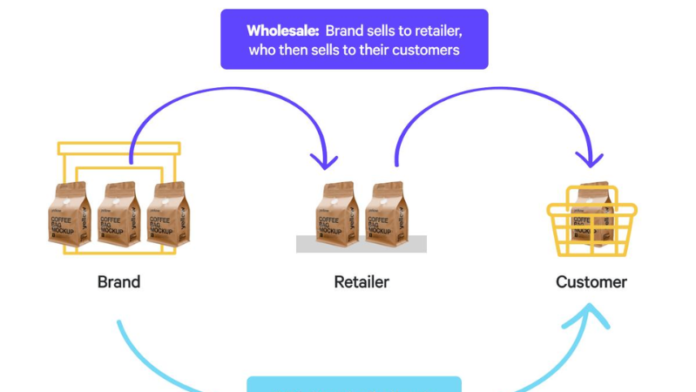
With wholesale distribution, your business sells products in larger quantities to retailers, distributors, or other companies. Those businesses then sell the products to their own customers.
With DTC, you remove that middle layer and sell directly to the end customer through channels such as your ecommerce website, physical store, app, or other owned channels.
Here’s the difference:
| Factor | Wholesale Distribution | Direct-to-Consumer (DTC) |
| Main customer | Retailers, distributors, businesses | Individual consumers |
| Typical order size | Large and less frequent | Smaller and more frequent |
| Price per unit | Usually lower | Usually full retail price |
| Customer relationship | Often managed through retail partners | Directly managed by the brand |
| Customer data | More limited | More detailed first-party data |
| Marketing responsibility | Shared with retail partners | Mostly handled by the brand |
| Fulfillment | Often bulk or partner-assisted | Brand manages individual orders |
| Brand control | Lower | Higher |
| Customer service | Shared or indirect | Brand handles it directly |
| Scalability | Strong for volume and distribution | Strong for relationship and brand building |
How Does Wholesale Distribution Work?
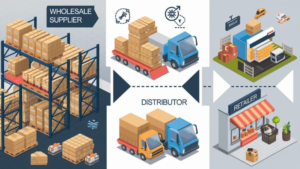
Wholesale is built around volume. Instead of selling 20 individual products to 20 different consumers, you might sell 400 units to one retailer. The retailer then takes care of selling those products to its customers.
The wholesale price is normally lower than the final retail price because the retailer needs enough room to cover its own costs and make a profit.
For a growing manufacturer or product company, this can be extremely attractive. One successful retail account can put hundreds or thousands of products into the market without the brand having to acquire every individual customer itself.
Wholesale partners can also contribute to product discovery, merchandising, delivery, and consumer-facing sales.
Why businesses choose wholesale
Wholesale is useful when a company wants:
- Bigger orders
- Greater dispersal
- More consistent replenishment
- Availability of established retail audiences
- Reduced requirements for fulfilling individual orders
- A reduced reliance on direct customer acquisition
- Possibilities to enter new geographical markets
The retailer may control the final customer experience, pricing decisions, merchandising, and much of the relationship with the person who ultimately buys your product.
How Does the DTC Business Model Work?
DTC takes a completely different approach.Instead of selling your products to another business and letting them handle the customer relationship, you sell directly to the person who wants your product.
That might happen through your own website, physical store, app, email marketing, social media, or another brand-controlled channel.
Imagine you make premium skincare products.
In a wholesale model, you might sell those products to a beauty retailer. The retailer puts them on shelves and sells them to shoppers.
With DTC, the customer visits your website, learns about the product, places an order, pays you, and receives the product from your fulfilment operation.
You control much more of that journey.
Why businesses choose DTC
A direct-to-consumer strategy can help businesses:
- Control their brand presentation
- Build direct customer relationships
- Collect first-party customer data
- Test new products faster
- Control pricing more closely
- Gather immediate customer feedback
- Develop stronger loyalty programs
- Personalize marketing
- Potentially capture more revenue per unit
Wholesale vs DTC: Which Offers Better Profit Margins?
This is one of the biggest questions business owners ask, and the answer isn’t as straightforward as “DTC has higher margins.”
Wholesale normally means a lower selling price per unit, but the business benefits from larger orders and potentially lower fulfillment costs per unit.
DTC allows you to charge the retail price, but you’re also taking on many expenses that a retailer would otherwise absorb.
Some of its Expenses are:
- Digital advertising
- Customer acquisition
- Ecommerce technology
- Packaging
- Individual shipping
- Returns
- Customer support
- Warehousing
- Payment processing
- Promotional campaigns
So, while DTC can generate more revenue per individual product, higher revenue per unit does not automatically mean higher overall profitability.
Wholesale vs DTC: Customer Relationships and Data
This is where DTC has a major advantage.
When someone purchases directly from your website, you can potentially understand much more about their relationship with your brand.
You can learn about:
- What they purchase
- How frequently they purchase
- Which products they view
- What offers they respond to
- Whether they return
- What products they prefer
- How much they spend over time
That information can help you improve products and create more relevant marketing.
In wholesale, the retailer usually has a much closer relationship with the final shopper. As a result, the manufacturer or wholesaler may have less visibility into the end customer’s behaviour.
Wholesale vs DTC: Which Gives You More Brand Control?
If the brand is your first priority, DTC gives more control.
It can decide:
- How your products are presented
- What your website looks like
- How prices are displayed
- What your customers see first
- What your brand sounds like
- How promotions work
- How customer service is delivered
With wholesale, your products appear alongside many other brands. Retailers may have their own merchandising strategies, discounting policies, and customer experience.
That doesn’t make wholesale bad. In fact, the retailer’s reputation can actually strengthen your brand.
The key difference is simply control versus reach.
Advantages of Wholesale Distribution
Wholesale remains attractive for many businesses because it can make scaling physical products easier.
- It has Larger order volumes
- Wider market reach
- More predictable purchasing
- Lower individual fulfillment burden
- Potentially lower customer acquisition costs
- Stronger physical presence
- Easier geographic expansion
Disadvantages of Wholesale Distribution
Wholesale isn’t without challenges.
- Lower per-unit revenue
- Less customer data
- Less control
- Dependence on business accounts
- Longer sales cycles
Advantages of Direct-to-Consumer (DTC)
DTC has become attractive because it puts the customer relationship directly in the hands of the brand.
- Direct customer relationships
- Better access to first-party data
- Greater pricing control
- Stronger brand experience
- Faster customer feedback
- Easier product testing
- Potentially higher revenue per order
Disadvantages of DTC
The freedom of DTC comes with a bigger workload.
- Customer acquisition can be expensive
- You handle the entire customer experience
- Marketing never really stops
- More operational complexity
- Revenue can be less predictable
Wholesale Distribution vs DTC: Which Is Better for Small Businesses?
For a small business, the answer depends heavily on what you’re selling and how you’re positioned.
Wholesale may be a better fit if:
- Your products sell well in volume.
- Retailers are actively interested in your category.
- You want wider physical distribution.
- You have limited capacity for individual fulfilment.
- You prefer larger B2B accounts.
- Your product doesn’t require extensive consumer education.
DTC may be better if:
- Your product is highly personalised.
- Your brand depends on storytelling.
- Customer relationships are important.
- You can invest in ecommerce and marketing.
- You want detailed customer data.
- Your customers are comfortable buying online.
- You want to test products directly with consumers.
But there is another option that deserves serious attention.
How to Decide Between Wholesale and DTC
Before committing to either model, ask yourself these questions.
- Who is your ideal customer?
- What’s your average order size?
- How important is personalisation?
- How much capital do you have?
- How strong is your brand?
- Can your team handle individual orders?
- How valuable is customer data to your business?
- Do you need rapid physical distribution?
Wholesale Distribution vs DTC in 2026: What Businesses Should Know
The boundary between B2B and consumer ecommerce is becoming less rigid.
Business buyers increasingly expect convenient digital experiences, including self-service ordering, real-time information, and easier online purchasing. The source material notes that 84% of B2B buyers surveyed by Contentful said self-service tools were critical when choosing a vendor.
That means a wholesale business can’t necessarily rely on an old-fashioned sales process forever.
Today’s wholesale customer may expect:
- Online catalogs
- Account-specific pricing
- Real-time inventory
- Easy reordering
- Digital invoices
- Self-service purchasing
- Quick communication
- Mobile-friendly experiences
Conclusion
Selecting a winner based solely on whatever business strategy seems more appealing on paper is not necessary. DTC and wholesale distribution address different issues. Working with reputable retailers, expanding thru bigger orders, and getting goods into more hands are all made possible by wholesale. DTC, on the other hand, gives you greater control over the purchasing process, allows you to stay in touch with your clients, and helps you learn what they truly want.
One model will obviously make more sense for certain businesses. For others, it could be wiser to use both DTC and wholesale. Making decisions based on your customers, margins, resources, and long-term objectives rather than just what other brands are doing is important.
FAQs
What is the difference between wholesale distribution and DTC?
The biggest difference comes down to who buys your product from you. In wholesale, you sell to retailers, distributors, or other businesses, which then sell the product to their own customers. With DTC, you skip that middle step and sell directly to the people who will actually use the product.
Is DTC more profitable than wholesale?
It can be, but not automatically. DTC allows you to sell at your own retail price, but you also have to pay for things such as advertising, website management, shipping, packaging, returns, and customer support. A higher selling price doesn’t always translate into higher profit.
What are the main benefits of a DTC business model?
DTC gives you a much closer connection with your customers. You can control how your brand is presented, communicate directly with buyers, gather customer feedback, understand purchasing behaviour, experiment with products, and create a more personalized shopping experience.
Can I sell wholesale and directly to consumers?
Yes. Many businesses use both channels. You could sell your products through retailers while also maintaining your own website or online store. This gives you the opportunity to benefit from wholesale distribution while still developing a direct relationship with your customers.
What is a hybrid wholesale and DTC business model?
A hybrid wholesale and DTC model simply means selling through both business partners and direct consumer channels. For example, a clothing brand might supply products to retail stores while also selling the same collection through its own website.
Is DTC more difficult to manage than wholesale?
It can be, particularly as order volume increases. With DTC, you’re dealing with individual customers, orders, shipping, returns, payments, questions, complaints, and marketing. Wholesale usually involves fewer but larger orders, although managing retailer relationships comes with its own challenges.
Should a new product business start with wholesale or DTC?
It depends on the product and the resources behind the business. DTC can be useful when you want to test products and hear directly from customers. Wholesale can be helpful when you want to get products into established stores and reach an existing customer base.
Is DTC better for customer loyalty?
DTC can make loyalty-building easier because you have a direct line to the customer. You can communicate through email, offer loyalty rewards, create subscriptions, recommend products, and collect feedback without relying on a retailer to manage the relationship.
Can selling wholesale and DTC at the same time cause problems?
It can if the two channels aren’t managed carefully. For example, offering your products at a much lower price on your own website could frustrate wholesale partners. Businesses using both channels should think carefully about pricing, promotions, inventory, and how each sales channel fits into the overall strategy.