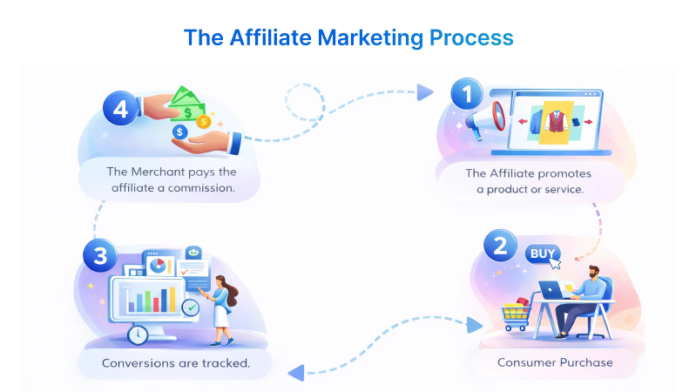
Sometimes people ask about your product, such as a pair of shoes, a smartphone, clothes, or gadgets. Imagine being compensated each time a customer purchases that item because of your suggestion.
One of the most well-liked methods of making money online is affiliate marketing. Affiliate marketing provides a flexible approach to make money without producing your own goods or handling inventory, regardless of whether you’re a blogger, YouTuber, social media developer, or just someone searching for a side gig.
The best part? You don’t need a huge investment to get started. All you need is the right strategy, useful content, and an audience that trusts your recommendations.
In this beginner-friendly guide, you’ll learn what affiliate marketing is, how it works, the different ways affiliates earn money, and how you can start your own affiliate marketing journey.
What Is Affiliate Marketing?
Affiliate marketing is a performance-based marketing model where you earn a commission for promoting another company’s products or services.
Instead of selling your own products, you recommend a brand’s products using a unique affiliate link. If someone clicks your link and makes a purchase or completes another required action, you earn a commission.
Think of yourself as the bridge between a business and potential customers.
For example, if you write a blog reviewing laptops and recommend one through an affiliate link, you’ll earn a commission every time a reader buys that laptop through your recommendation.
It’s a win-win situation:
- Businesses get more customers.
- Affiliates earn money for driving sales.
- Customers discover products that solve their problems.
How Does Affiliate Marketing Work?
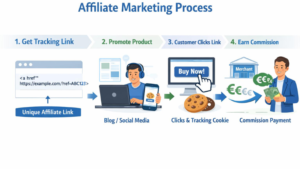
Affiliate marketing may sound complicated, but the process is actually very simple.
Here’s how it works step by step.
Step 1: Join an Affiliate Program
The first step is signing up for an affiliate program offered by a company or an affiliate network.
Once approved, you’ll receive a unique affiliate link that tracks every visitor you send.
Step 2: Promote the Product
After that, you distribute your affiliate link via various channels, such as:
- Posts on blogs
- Videos on YouTube
- TikTok
- Newsletters via email
- Podcasts
The objective is to help individuals solve an issue by suggesting helpful items, not just distributing links.
Step 3: Someone Clicks Your Link
When a visitor clicks your affiliate link, a tracking cookie is stored in their browser.
This cookie tells the company that you referred the customer.
Step 4: The Customer Makes a Purchase
If the customer buys the product before the cookie expires, the sale is credited to you.
Step 5: You Earn a Commission
Once the sale is confirmed, the company pays you a commission.
Some programs pay within a few weeks, while others pay monthly.
Who Are the Three Main Players in Affiliate Marketing?
Every affiliate sale involves three important people.
1. The Seller
The seller is the company or business that owns the product.
Examples include:
- Amazon
- Shopify
- Hostinger
- Adobe
- Nike
They create the product, handle payments, shipping, and customer support.
2. The Affiliate
The affiliate is the marketer who promotes the product.
Affiliates can be:
- Bloggers
- YouTubers
- Influencers
- Website owners
- Email marketers
- Social media creators
Their job is to attract potential buyers.
3. The Customer
The customer purchases the product through the affiliate link.
Without customers, nobody earns money.
Different Types of Affiliate Marketing
Not every affiliate promotes products in the same way.
Here are the three most common approaches.
Unattached Affiliate Marketing
This is the simplest method.
You promote products without personally using them.
Most affiliates use paid ads or PPC campaigns to generate sales.
Pros:
- Fast to start
- No personal experience needed
Cons:
- Lower trust
- Harder to build a loyal audience
Related Affiliate Marketing
In this model, you already have an audience in a particular niche.
You may not have personally used every product, but your audience trusts your expertise.
For example, a travel blogger recommending luggage brands.
Involved Affiliate Marketing
This is considered the most effective and trustworthy approach.
You personally use the product before recommending it.
Your reviews include real experiences, honest opinions, and practical advice.
Because your audience trusts your recommendations, conversion rates are often much higher.
How Do Affiliate Marketers Get Paid?
Different payment schemes are used by affiliate programs.
PPS, or pay per sale
The most popular model is this one.
Every time someone makes a purchase using your affiliate link, you get paid.
For instance:
You will receive ₹1,000 for each sale of a ₹10,000 product that offers a 10% commission.
PPL, or pay per lead
Rather than demanding a purchase, the business makes payment when someone:
- Enrolls
- Asks for a demonstration
- Completes a form
- Initiates a complimentary trial
Financial services, insurance, and software all use this paradigm.
Pay Per Click (PPC)
Some affiliate programs pay simply for sending traffic.
Although less common today, certain advertising programs still use this model.
Pay Per Install (PPI)
Mostly used by software companies.
You earn money whenever someone downloads and installs an application.
Where Can You Promote Affiliate Products?
Affiliate marketing isn’t limited to blogs.
Here are the most popular platforms.
- Blogging
- YouTube
- Social Media
- Email Marketing
- Podcasts
Benefits of Affiliate Marketing
There are plenty of reasons why affiliate marketing continues to grow every year.
Some of the biggest advantages include:
- Low startup costs
- No inventory management
- No shipping responsibilities
- Flexible working hours
- Work from anywhere
- Passive income potential
- Unlimited earning opportunities
- Easy to scale over time
Challenges of Affiliate Marketing
While affiliate marketing sounds attractive, it isn’t a get-rich-quick business.
Some common challenges include:
- Building traffic takes time.
- Competition can be high.
- Income isn’t guaranteed.
- SEO and social media algorithms constantly change.
- Trust takes years to build.
Patience and consistency are essential.
How to Start Affiliate Marketing as a Beginner
If you’re completely new, here’s a simple roadmap.
Choose a Niche
Pick one topic you enjoy.
Popular niches include:
- Technology
- Personal finance
- Fitness
- Beauty
- Travel
- Education
- Home improvement
Build an Audience
Start creating content through:
- A blog
- YouTube channel
- Instagram page
- Email newsletter
Focus on helping people—not selling.
Join Affiliate Programs
Some of the Popular beginner-friendly programs include:
- Amazon Associates
- Shopify Affiliate Program
- Hostinger
- Canva
- Adobe
- BigCommerce
- CJ Affiliate
- Impact
- Awin
Track Your Results
Use tools like:
- Google Analytics
- Affiliate dashboards
- Link tracking software
Identify what works and improve it over time.
Conclusion
Increasing sales and providing a win-win solution for the affiliate and the merchant are the objectives of affiliate marketing. Understanding affiliate marketing’s benefits and drawbacks can help those who want to pursue it. It will be advantageous for businesses looking for affiliates to thoroughly screen and qualify their partners. All things considered, it is an inexpensive and efficient method of promoting goods and services, raising brand recognition, and growing a customer base.
FAQs
What is affiliate marketing in simple words?
Making money by endorsing someone else’s goods or services is known as affiliate marketing. You are paid by the business when someone makes a purchase using your special affiliate link.
Is affiliate marketing free to start?
Yes, affiliate marketing can be started with very little or no investment. You can begin by creating content on a blog, YouTube channel, or social media account and joining free affiliate programs.
What’s the biggest mistake beginners usually make?
One of the biggest mistakes is trying to sell everything. People are more likely to trust your recommendations when you focus on products that actually fit your niche and that you genuinely believe are useful.
Can I do affiliate marketing alongside my full-time job?
Yes. In fact, many people start affiliate marketing as a side hustle. Since you can work whenever it suits you, it’s possible to create content during evenings or weekends and gradually build an additional source of income.
Can affiliate marketing become a full-time career?
Yes, many creators have turned affiliate marketing into a full-time business. It usually takes time, consistency, and patience, but as your audience grows, your affiliate income can grow along with it.