Investors are regularly confused by the Alphabet’s dual-class share structure (GOOGL vs. GOOG). We’ll examine the main differences between GOOGL (Class A) and GOOG (Class C) shares, reveal the historical justification for their existence, and offer practical advice to help you choose the share class that best suits your investing objectives. In the end, you’ll have a solid grasp of the technical aspects and their usefulness for your portfolio.
Deconstructing Alphabet’s Share Classes
Fundamentally, there is only one important characteristic that separates GOOGL from GOOG: voting rights. Like a few other tech behemoths, Alphabet has a multi-class share structure that allows for public investment while centralizing power.
Class A (GOOGL): The Voting Share
You are looking at Alphabet’s Class A common shares when you see the ticker GOOGL. Each of these shares has one vote and is openly traded on the NASDAQ exchange. This implies that you theoretically have a voice in business decisions, such as choosing board members or approving significant business plans, if you own GOOGL shares. Consider it akin to conventional common stock, in which ownership entitles one to participate in the management of the business.
Class C (GOOG): The Non-Voting Share
On the other hand, Alphabet’s Class C capital stock is represented by GOOG. Crucially, these shares have no voting rights at all, while being openly traded on the NASDAQ. With no direct control over business choices, investors who own GOOG shares are essentially investing only for the financial exposure to Alphabet’s performance. The purpose of this class was to enable the company to raise funds without reducing the voting power of its insiders and founders.
Class B: The Founders’ Shares (Not Publicly Traded)
A third class of shares exists in addition to the publicly traded GOOGL and GOOG: Class B shares. Alphabet’s founders, Larry Page and Sergey Brin, as well as a few other early insiders, own the majority of these shares, which are not publicly traded. The increased voting power of Class B shares each Class B share has ten votes is their key feature. The founders maintain substantial control over the company’s long-term goals and strategic direction despite public ownership thanks to this super-voting arrangement.
The Historical Context: Why did Google (Alphabet) stock split?
Alphabet’s decision to have two public share classes isn’t random; rather, it stems from a calculated plan to preserve founder control.
The 2014 Stock Split and Control Retention
A stock split that took place in April 2014 is when the GOOG and GOOGL differentiation originated. Prior to this split, there were just Class A shares, which were then known by the ticker GOOG. The founders of Google looked for a way to issue more shares for capital raising, staff compensation, and acquisitions without reducing their collective voting power in order to protect the company from short-term market pressures and maintain its visionary leadership.
It’s non-voting Class C shares (GOOG) were essentially created by a 2-for-1 stock split. An investor receives one new Class C share for each Class A share they already owned. This clever strategy preserved the founders’ proportionate voting power through their super-voting Class B shares while enabling Alphabet to virtually treble its outstanding shares. It is a prime illustration of a “dual-class share structure,” which favors long-term visionaries over possible activist stockholders.
Economic Parity vs. Governance Power: What Truly Matters?
Now that we know the fundamental distinction, let’s tackle the important query for individual investors: Do you think voting rights are important?
Understanding Voting Rights: Do They Matter for You?
The voting rights linked to GOOGL shares have little real influence over the great majority of individual retail investors. Why? Think about this: compared to the combined voting power of institutional investors and, more significantly, the founders’ Class B shares, your one vote, or even a few hundred votes, is like a grain of sand on a huge beach. The majority of shareholder votes are essentially a formality because Larry Page and Sergey Brin have a super-majority of the voting power thanks to their Class B shares.
Therefore, for small to moderate investors, owning GOOGL has little practical impact on important company decisions, even though it theoretically offers you a voice. Owning GOOGL shares in a typical retail number is unlikely to give you the power you need if your main objective is to influence board elections or business policy.
Identical Economic Interest: Dividends, Stock Splits, and Value
The economic advantages of the two shared classes are where they fully line. Your financial exposure to Alphabet’s success is the same whether you own GOOGL or
GOOG. They both attend the same classes:
Get the same dividends: The dividend amount per share is the same for both GOOGL and GOOG owners.
Benefit equally from stock splits: In the recent 2022 stock split, each share was divided 20-for-1, resulting in equal participation from both share classes.
Represent the same underlying ownership stake: Whether through a Class A or Class C share, you own a portion of the same company, Alphabet, with all of its varied revenue streams, creative projects, and potential for future growth.
Therefore, there is no distinction between owning GOOGL and GOOG in terms of the observable financial gains from Alphabet’s business success, such as revenue growth, profitability, or asset value.
Price Dynamics: Are GOOG and GOOGL Different?
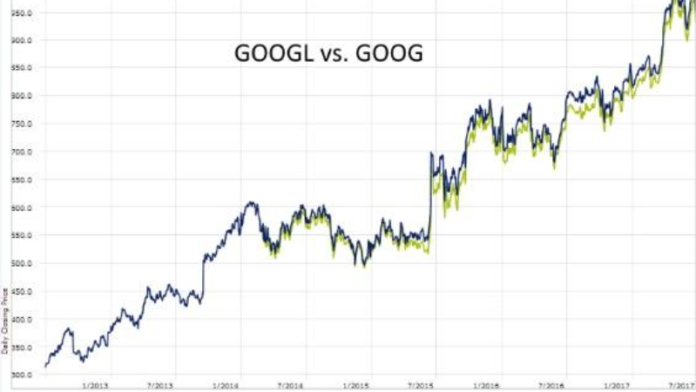
In the past, GOOGL and GOOG prices have tended to move almost exactly in lockstep. Both share classes react nearly identically to changes in Alphabet’s overall market valuation. The main cause of this strong association is arbitrage: skilled traders swiftly spot and take advantage of any notable price discrepancies by purchasing the less expensive class and selling the more expensive one, thus bringing their prices back into balance.
Sometimes, though, there are small differences. One may be trading at a slight premium (typically GOOGL because of its voting rights) or a slight discount (occasionally GOOG because of somewhat better liquidity in rare situations). These variations are frequently transient and usually fall within the range of fractions of a percentage point.
Factors Influencing the Slight Price Spread
While often negligible, some factors can contribute to temporary minor price spreads:
Perceived Value of Voting Rights: The voting rights associated with GOOGL should, in theory, fetch a little premium. This premium may slightly increase during periods of company uncertainty or possible activist investor participation (which is uncommon for Alphabet given its structure).
Liquidity and Trading Volume: One class may occasionally have somewhat greater trading volume or liquidity, which may have a small short-term impact on its price depending on supply and demand dynamics.
Specific Share Buyback Programs: Alphabet has occasionally carried out share buyback initiatives that may favor one class over another, causing brief market distortions.
Employee Stock Grants: Class C (GOOG) shares make up a sizable amount of employee remuneration at Alphabet. The market dynamics may occasionally be impacted by this constant flow of shares, although buybacks frequently counteract this.
Class C (GOOG) shares make up a sizable amount of employee remuneration at Alphabet. The market dynamics may occasionally be impacted by this constant flow of shares, although buybacks frequently counteract this.
Which Alphabet Share is Right for Your Portfolio?
Although the actual difference is negligible for most, the decision between GOOGL and GOOG primarily hinges on your personal investment philosophy and preferences.
| Feature | GOOGL (Class A) | GOOG (Class C) |
| Ticker Symbol | GOOGL | GOOG |
| Voting Rights | One vote per share | No voting rights |
| Economic Interest | Identical to GOOG (dividends, splits, value) | Identical to GOOGL (dividends, splits, value) |
| Price Tendency | Usually trades at a slight premium (often negligible) | Usually trades at a slight discount (often negligible) |
| Target Investor | Those who prefer theoretical corporate governance participation | Those focused purely on economic exposure to Alphabet’s performance |
| Historical Origin | Original common stock, kept voting rights after 2014 split | Created in 2014 stock split to raise capital without diluting founder control |
Conclusion
At the end of the day, the difference between GOOGL and GOOG is much simpler than it may first appear. The main distinction is voting rights GOOGL shareholders get one vote per share, while GOOG shareholders do not have voting rights. Beyond that, both share classes give investors exposure to the same company, Alphabet, and benefit from its growth, innovation, stock splits, and any future dividend distributions.
FAQ
Do GOOGL and GOOG have different returns?
Historically, both stocks have delivered very similar returns because they represent ownership in the same company and tend to move almost identically in the market.
Do GOOG shareholders own part of Alphabet?
Yes. GOOG shareholders own a portion of Alphabet and benefit from the company’s growth, even though they do not have voting rights.
Do GOOGL and GOOG pay different dividends?
No. If Alphabet pays dividends, both GOOGL and GOOG shareholders would receive the same dividend amount per share.
Why does GOOGL sometimes trade at a higher price than GOOG?
GOOGL occasionally trades at a small premium because it includes voting rights, which some investors view as having additional value.
Are GOOGL and GOOG included in major stock indexes?
Yes. Both share classes are included in several major market indexes and are widely followed by investors around the world.