Although launching a business might be thrilling, there are many things to learn before you feel at ease in the role of owner. Selecting a business structure is one of the first choices you will have to make.
A limited liability company (LLC) or a sole proprietorship is one of the two most popular choices for individuals launching small businesses in the United States.
They may initially appear to be fairly similar. You can manage either kind of business independently, interact with customers, sell goods, and gradually increase your revenue. When you consider items like personal liability, taxes, paperwork, expenses, and growth goals, the true disparities become apparent.
Let’s operate from your spare bedroom as a freelance designer. Or you might be an independent consultant, a hairstylist with your own clientele, or an internet vendor of handmade goods. You could begin as a sole owner, but as your company expands, you could start to consider whether an LLC would be a better option.
About Sole Proprietorship?
A sole proprietorship is a type of business. You are the company’s owner, manager, and decision-maker. You and the company itself are not separated by a different corporate entity.
This simplicity may be enticing to someone who is simply testing a concept or launching a tiny side business. Formal business obligations don’t need to take up much of your time before you can focus on the activity that really generates revenue.
The ease of filing taxes is an additional benefit. You are not dealing with the same degree of separation that comes with a more formal business entity because business income and expenses typically pass through to your personal tax return.
This does not imply that there are no obligations or rules. You still have to monitor your earnings, outlays, contracts, licenses, and other business-related documents.
About LLC?

An LLC, or limited liability company, creates a more formal structure for your business.
It is a distinct legal business entity from a sole proprietorship. One of the primary factors influencing the business owners’ decisions is this division.
The biggest attraction is usually personal asset protection. In general, an LLC can help separate the owner’s personal assets from the company’s debts and liabilities. So, instead of automatically putting your personal savings, home, or vehicle at the same level of risk as the business, there is a legal boundary between the two.
You may begin with a single-member LLC and carry on managing the company alone. Later on, you can want to change the company’s tax structure, hire staff, enter a new market, or add a new owner.
LLC vs Sole Proprietorship: What Is the Difference?
Examining how these two structures address some of the practical aspects of managing a corporation is the simplest approach to comprehending them.
Personal Liability
One of the main distinctions between an LLC and a sole proprietorship is this.
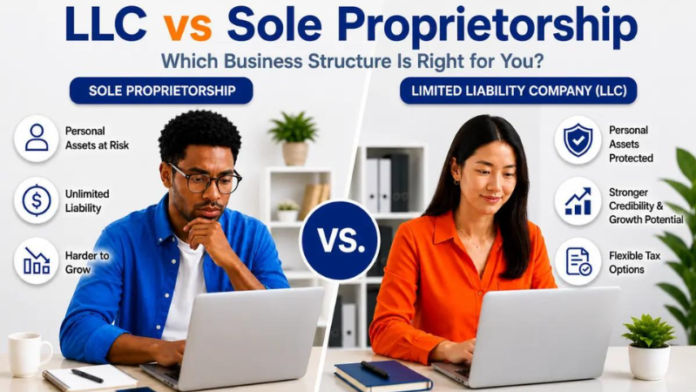
The owner and the business are mostly seen as one and the same in a sole proprietorship. If the business has certain debts or legal problems, your personal assets may also be in jeopardy.
A layer of security between the company and its owner is typically offered by an LLC. Generally speaking, personal assets are shielded from numerous business-related debts and legal actions.
Taxes
Profits and losses for a sole proprietorship often appear on your personal tax return. That can make things simpler to comprehend and handle for a lone small business proprietor.
An LLC may be taxed as an S corporation, C corporation, partnership, or sole proprietorship, depending on the situation. As the business and revenue fluctuate, this allows the owner greater freedom.
It’s crucial to keep in mind that having more options does not always translate into reduced taxes. However, the best option will rely on your income, the firm’s operations, and your long-term objectives.
Paperwork and Administration
Nobody starts a business because they love paperwork.
That is one reason sole proprietorships appeal to so many new entrepreneurs. They are generally easier to manage and have fewer formal requirements.
Benefits of a Sole Proprietorship

For the people who want to keep their business simple, a sole proprietorship is best for them. It is best for those who offer services such as consulting, writing, photography, design, tuition, or other independent labour.
Here are a few of the main benefits: It is simple to begin. Some of the formal setup required to incorporate an LLC can be avoided.
It might be less expensive. When compared to an LLC, the formation charges are typically lower.
You are in total control. Business choices are made without the involvement of partners or other members.
Reporting taxes is not that difficult. Generally, your personal tax return includes your company revenue and expenses.
Benefits of an LLC
In addition to being more involved, an LLC provides several benefits that a sole proprietorship does not.
- Protection of Personal Assets
- Increased Tax Flexibility
- The business structure is more formal.
- It Makes the Growth of Plans Easier
Sole proprietorship vs. LLC: Which one fits you best?

Whether you choose an LLC or a sole proprietorship, the structure you choose will have an impact on how you manage risk, pay taxes, operate, and expand over time. While LLCs provide more legal protection and greater credibility with lenders and customers, sole proprietorships are the best option for individuals seeking a rapid, low-cost launch with little red tape.
Use the Starter Suite to begin your adventure right now. Want to add more personalisation? Examine Pro Suite. Are you a Salesforce client already? Try out Agentforce and activate Foundations right now.
Conclusion
There are benefits and drawbacks to both LLCs and sole proprietorships. All depends on what is best for your company.
When you are working alone, keeping expenses down, and managing a fairly straightforward firm, a sole proprietorship can be a pleasant place to start. You don’t have to spend as much time on business administration, and there are fewer formal procedures and paperwork.
An LLC requires a bit more work. You have to cope with continuing obligations, state procedures, and formation paperwork. In exchange, you receive a formal business structure and, in general, more security between the company and your personal assets.
FAQ
Is an LLC better than a sole proprietorship?
Not always. An LLC gives a more formal structure and typically affords better protection for personal assets from business obligations, but a sole proprietorship is easier and typically less expensive
Is it easier to pay taxes as a sole proprietor?
Yes, for a lot of small business entrepreneurs. Tax filing can be somewhat simple because business income and costs are typically reported on the owner’s personal tax return.
Can an LLC have different tax treatment?
Yes. Depending on the circumstances, an LLC may be taxed as a sole proprietorship, partnership, S corporation, or C corporation.
Can I run an online business as a sole proprietor?
Yes. An online business can operate as a sole proprietorship, although you may still have licensing, registration, tax, or other requirements depending on where and how you operate.