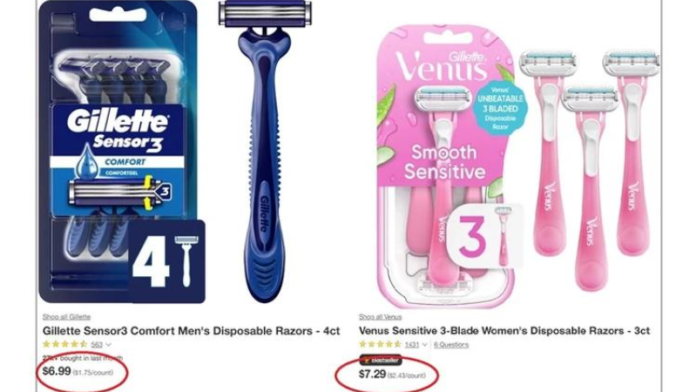
Have you ever picked up two products that do almost exactly the same thing, only to notice that the one marketed toward women costs more?
Maybe it was a razor. Maybe shampoo, deodorant, clothing, or even a children’s toy.
That kind of price difference is often described as the pink tax.
The name can be a little confusing because the pink tax is not an actual tax added by the government. Instead, it refers to a situation where products and services marketed toward women and girls cost more than similar products aimed at men and boys.
Sometimes the difference is obvious. Other times, it is hidden behind packaging, colours, scents, branding, or the way the product is advertised.
The bigger question is why these differences happen and what they mean for consumers. When you look at one purchase, the extra amount may not seem like much. But repeated price differences across everyday items can add up over time.
What Is the Pink Tax?
The pink tax is a term used to describe higher prices for products marketed toward women and girls compared with similar products marketed toward men and boys.
It is also linked to gender pricing and price discrimination.
For example, imagine two razors that are made for the same basic purpose. One is packaged in a traditionally feminine colour and marketed to women, while the other is marketed to men. If the women’s razor costs more even though the products are very similar, that price difference may be described as a pink tax.
The same idea can apply to products such as shampoo, conditioner, deodorant, lotion, clothing, toys, and other personal care items.
The key point is that the higher price is not necessarily caused by higher production or manufacturing costs. It can instead come from the way a company positions and prices the product.
Is the Pink Tax a Real Tax?
No. The pink tax is not a government tax.
There is no special tax that automatically gets added to products simply because women buy them. The term is used to describe price differences between similar products marketed toward different genders.
This distinction is important because the issue is about how products are priced and marketed rather than a tax collected by the government.
A company may believe that a particular group of customers is willing to pay more for certain features, branding, or presentation. That can influence the final price on the shelf.
What Is Price Discrimination?
Price discrimination happens when a business charges different prices for the same or very similar products.
The reasoning behind the pricing can vary. A company may separate customers into different groups and set prices based on what it believes each group is willing to pay.
This is where the idea of the pink tax comes in.
When a women’s product and a men’s product are almost the same but are sold at different prices, consumers may question whether the difference is justified by actual costs or simply by the way the products are marketed.
For example, a shampoo may work in much the same way regardless of whether the bottle is designed for men or women. Yet packaging, fragrance, branding, and positioning can create a different price point.
Why Does the Pink Tax Exist?
There isn’t one single reason behind the pink tax.
A combination of gendered marketing, consumer habits, social expectations, pricing strategies, and profit motives can help explain why these price differences appear.
Companies often create products for specific groups of customers. When a product is designed and marketed specifically toward women, businesses may present it as more specialised, attractive, luxurious, or necessary.
There are also social expectations surrounding appearance and self-care. Women may face greater pressure to spend money on grooming, clothing, cosmetics, and personal care.
The result can be a situation where consumers are willing to pay more for something simply because it has been presented as a product specifically for women.
How Do Marketing and Branding Contribute to the Pink Tax?
Marketing can have a surprisingly large influence on what shoppers are willing to pay.
Products aimed at women often use different colours, designs, fragrances, packaging, and advertising messages. These choices can make an ordinary product appear more specialised or premium.
The problem is that a different appearance does not automatically mean a product costs much more to make.
A pink razor and a blue razor, for instance, may require similar materials and manufacturing processes. However, if customers associate one with a more specialised experience, a company may decide to charge a different price.
This is why the discussion around the pink tax often goes beyond manufacturing costs. It also looks at perceived value and what businesses think different customer groups are willing to spend.
What Are Some Examples of the Pink Tax?
The pink tax can appear in many ordinary purchases.
Personal care products are some of the most common examples, including razors, shampoo, conditioner, deodorant, and lotion. But the issue can also show up in children’s products and clothing.
A study from the New York City Department of Consumer Affairs found that girls’ toys and accessories cost an average of 7% more than comparable products for boys. In the study, helmets and pads showed a difference of nearly 13%.
These differences may not apply to every brand or every product, but the research helps demonstrate why gender-based pricing has attracted attention.
Personal Care Products
Personal care products are frequently mentioned when discussing the pink tax.
The same New York City study found that personal care products marketed toward women cost 13% more than comparable products marketed toward men. Hair care had one of the largest gaps, with women paying about 48% more for shampoo and conditioner in the products examined.
Think about how often people buy these products. Shampoo and deodorant aren’t usually one-time purchases.
Clothing
Clothing is another area where price differences have been observed.
The New York City study found that women’s jeans were roughly 10% more expensive than comparable men’s jeans, while women’s shirts were about 15% higher. Differences were also found in children’s clothing, with girls’ jeans costing around 8% more and girls’ shirts around 13% more than comparable boys’ clothing.
Again, individual products can vary, but these findings show how pricing differences can extend beyond cosmetics and personal care.
Deodorant and Body Wash
A 2021 analysis by Parsehub found that women in Canada were paying more than 50% extra for some deodorant and body wash products compared with men’s versions at major retailers.
Examples like this are one reason consumers are encouraged to compare products based on their ingredients, function, size, and unit price instead of simply choosing the version marketed to their gender.
Pain Relief Products
The discussion has also extended to healthcare-related purchases.
CBC’s Marketplace compared pain relief products and found that a product marketed specifically for period pain was priced at $16.99, while a headache painkiller cost $13.99. The products were described as very similar, although the period-pain product was marketed and displayed differently.
Examples involving healthcare products can be particularly important because people may not feel they have much choice when they need a specific product.
How Does the Pink Tax Affect Women?
The financial impact of the pink tax becomes more significant when you look at repeated spending rather than a single purchase.
Women frequently purchase apparel, hygiene goods, and personal care items.
According to a 2024 Intrum study, women spent an average of 64% of their income on necessities, while men spent 53%.
This does not mean every higher-priced women’s product is automatically an example of the pink tax. Products can have legitimate differences in ingredients, design, quality, or manufacturing costs.
The concern arises when very similar products have different prices without a clear cost-based explanation.
How Does the Pink Tax Affect Women in Low-Income Countries?
The impact can be especially difficult for women with limited incomes.
Women in low-income countries may also face fewer alternatives, weaker consumer protections, or less competition in some markets.
When essential hygiene products become too expensive, some women and girls may be forced to reduce their use or rely on less suitable alternatives.
This can affect health, dignity, education, and participation in daily life. For example, a lack of affordable menstrual products can contribute to girls missing school.
How Does the Pink Tax Connect to Gender Stereotypes?
Gender stereotypes can influence how products are created and marketed.
Women are often expected to spend more time and money on appearance, grooming, hygiene, and self-care. Businesses can build marketing strategies around these expectations.
A product may be presented as more feminine by using certain colours, fragrances, packaging, or messages about beauty and appearance. These differences can encourage consumers to see the product as a separate or more specialised option, even when its basic function is very similar to another product.
That is one reason the pink tax is often discussed alongside broader questions about gender norms and economic inequality.
Does the Pink Tax Increase Economic Inequality?
The effect of the pink tax is not only about paying a few extra dollars or pounds at the checkout.
When higher prices appear across many categories of everyday spending, they can reduce the money available for savings, education, housing, or other financial goals.
This can be especially difficult for people who already have lower incomes.
The source material notes that women may face both higher consumer costs and lower economic advantages, creating a broader financial imbalance over time.
For marginalised communities, the burden can be even greater. Low-income women and other groups with fewer financial resources may have less flexibility to absorb higher prices.
How Can Consumers Avoid the Pink Tax?
Consumers don’t always have to buy the product that is marketed specifically to their gender.
One simple step is to compare products based on what they actually do rather than the packaging or advertising.
Check the unit price, compare ingredients and product sizes, and look at products marketed to everyone rather than only to women or men.
For example, a shopper might discover that a men’s razor or fragrance-free personal care product does the same job as a more expensive women’s version.
These small decisions can help people spend more carefully while also making price differences easier to spot.
What Can Businesses Do About the Pink Tax?
Businesses can also take steps to review their pricing practices.
One approach is to compare products marketed to men and women and check whether there is a genuine cost difference behind different prices.
Companies can choose gender-neutral pricing when products are essentially the same. They can also be more transparent about why certain products cost more.
There are examples of businesses changing their prices after consumers and advocacy groups highlighted gender-based differences. In the UK, Boots reduced the price of certain women’s razors to bring them closer to comparable men’s products.
What Role Do Government and Advocacy Play?
Consumers are not the only people who can challenge unfair pricing.
Awareness campaigns can bring attention to price differences and encourage companies to reconsider their practices. Policy and legislation can also play a role where gender-based pricing raises legal or consumer protection concerns.
One well-known example in the UK was Laura Coryton’s Stop Taxing Periods campaign. In 2015, the campaign’s petition and protest helped contribute to the UK government’s decision to remove VAT from menstrual products.
This makes it important to look at the laws and consumer protections that apply in a particular country rather than assuming the same rules exist everywhere.
Why Does Awareness of the Pink Tax Matter?
The pink tax matters because pricing can influence people’s everyday financial choices.
Most consumers don’t have time to investigate the production cost of every item they buy. They see a product on a shelf or website, compare a few prices, and make a decision.
Understanding the idea of the pink tax encourages shoppers to look a little closer.
It also raises a wider question about whether consumers should be paying more for a product because it is marketed differently, rather than because it genuinely costs more to make.
Awareness alone won’t eliminate every price difference, but it gives consumers more information when making purchasing decisions.
Conclusion
The pink tax is a simple term for a complicated issue.
It does not refer to a government tax. Instead, it describes the higher prices that women and girls may encounter when buying products that are similar to those marketed toward men and boys.
Sometimes there may be a genuine reason for a higher price, such as differences in materials, quality, design, or production. But when two products are very similar and one costs more largely because of gendered marketing, it is reasonable for consumers to question the difference.
For shoppers, one of the easiest ways to respond is to compare products based on their function, ingredients, size, and unit price rather than the colour of the packaging or the audience targeted by the advertisement.
FAQ
What does the pink tax mean?
The pink tax refers to the higher prices women and girls may pay for products or services that are similar to those marketed toward men and boys. It is not an actual government tax.
Why is it called the pink tax?
The term comes from the way many products for women have traditionally been marketed using feminine colours, especially pink. It describes a pricing difference rather than a literal tax.
What are common examples of the pink tax?
Common examples include razors, shampoo, conditioner, deodorant, clothing, toys, and some personal care products. Similar products may be priced differently depending on how they are marketed.
Is the pink tax illegal?
That depends on the country and the specific circumstances. Gender-based price differences are not automatically illegal everywhere, so local consumer and equality laws need to be considered.
Does the pink tax affect girls too?
Yes. Research has found price differences in products marketed toward girls, including toys, accessories, and children’s clothing.
How can consumers avoid the pink tax?
Compare products based on function, size, ingredients, and unit price. You can also look at products marketed as gender-neutral or toward another gender when the products are otherwise similar.
Can businesses help reduce the pink tax?
Yes. Businesses can review prices for similar products, use gender-neutral pricing where appropriate, and make their pricing decisions more transparent.
What is the difference between pink tax and tampon tax?
The pink tax refers to higher prices for products marketed toward women and girls. The term “tampon tax” has been used specifically for taxes applied to menstrual products, so the two concepts are different.