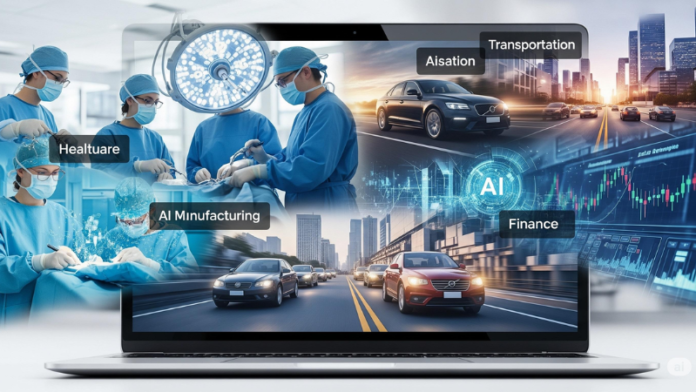
Artificial intelligence is no longer something used only by big technology companies. It is quickly becoming part of everyday business, from the way hospitals analyse information to how retailers recommend products and banks detect suspicious transactions.
What makes AI particularly powerful is its ability to handle large amounts of information, spot patterns, automate repetitive work, and help people make faster decisions.
As businesses continue adopting these tools, some industries are seeing especially strong growth around AI. In many cases, AI is not replacing the entire industry. Instead, it is creating new products, services, jobs, and business models within it.
So, what industries are growing because of AI, and why are they expanding so quickly?
Why Is AI Creating Growth Across So Many Industries?
AI is useful in almost any industry that deals with data, repetitive processes, customer interactions, or complex decision-making.
For businesses, the appeal is fairly simple. AI can help them work faster, understand customers better, reduce certain manual tasks, and find patterns that may be difficult to spot by hand.
It is also becoming easier for companies to add AI to tools they already use. That means businesses do not always need to build an AI system from scratch.
As adoption grows, demand also increases for people and companies that can develop, implement, manage, secure, and improve these systems.
Which Industries Are Growing the Most Because of AI?
AI is influencing many sectors, but some are seeing particularly strong activity.
| Industry | How AI Is Being Used | Growth Opportunities |
| Healthcare | Diagnosis support, medical research, administration | AI healthcare tools, data services, diagnostics |
| Finance | Fraud detection, risk analysis, customer service | Fintech, automated analysis, fraud prevention |
| Retail | Recommendations, inventory forecasting, customer support | Personalisation, automation, smart retail |
| Manufacturing | Predictive maintenance, quality control, robotics | Smart factories, industrial AI |
| Marketing | Content creation, customer insights, campaign optimisation | AI marketing platforms and services |
| Education | Personalised learning, tutoring, assessment support | AI learning tools and education platforms |
| Transportation | Route planning, fleet management, autonomous systems | Logistics technology and mobility solutions |
| Cybersecurity | Threat detection, monitoring, response | AI-powered security products |
| Agriculture | Crop monitoring, forecasting, automation | Precision farming and agricultural technology |
| Software | Coding assistance, testing, automation | AI-native software and developer tools |
How Is AI Changing the Healthcare Industry?

Healthcare is one of the most interesting areas for AI because medical organisations generate huge amounts of information.
AI can assist with areas such as medical image analysis, administrative tasks, research, patient monitoring, and clinical decision support.
For example, an AI system may help analyse medical images or organise patient information so healthcare professionals can review it more efficiently.
The growth is also creating demand for companies that build healthcare-specific AI systems, manage medical data, and develop tools that fit into existing healthcare workflows.
Human expertise remains essential, particularly when decisions can directly affect a patient’s health.
Why Is AI Helping the Finance Industry Grow?
Banks, insurance companies, payment providers, and fintech businesses deal with enormous amounts of financial data, making the sector a natural fit for AI.
AI is being used for tasks such as:
- Fraud detection
- Risk assessment
- Customer support
- Financial forecasting
- Document processing
- Transaction monitoring
- Personalised financial services
One major advantage is speed. An AI system can review large amounts of transaction data much faster than a person working manually.
This is helping create opportunities for fintech companies that specialise in fraud prevention, financial analysis, automation, and customer-facing AI tools.
How Is AI Transforming Retail and E-Commerce?
Online shopping has already made personalisation important, and AI is taking it further.
Retailers can use AI to understand buying behaviour, recommend products, forecast demand, improve inventory planning, and automate customer service.
Think about an online store that recommends products based on what a customer has viewed or purchased. Behind that simple experience, AI may be analysing a large number of signals.
AI can also help retailers predict which products are likely to sell, identify unusual changes in demand, and improve stock management.
This is creating growth in areas such as retail analytics, personalisation software, recommendation engines, and automated customer support.
Why Is Manufacturing Becoming More AI-Driven?
Manufacturing is another industry where AI can have a practical impact.
Factories can use AI to monitor machinery, detect defects, predict when equipment may need maintenance, and improve production planning.
Instead of waiting for a machine to break down, predictive systems can analyse signals that may indicate a potential problem.
AI is also being combined with robotics and computer vision to improve quality control and automation.
This is contributing to the growth of smart manufacturing, industrial software, robotics, and factory automation.
How Is AI Changing Marketing and Advertising?
Marketing has quickly become one of the most visible areas of AI adoption.
Businesses now use AI for tasks such as generating first drafts, analysing customer behaviour, segmenting audiences, testing ideas, and understanding campaign performance.
For marketers, one of the biggest advantages is speed. A task that previously took hours of manual research may be completed much faster with the right AI tools.
This is creating opportunities for AI marketing platforms, customer analytics, content tools, advertising technology, and specialised marketing services.
At the same time, human creativity still matters. AI can produce options quickly, but businesses still need people to decide what fits their audience and brand.
How Is AI Changing Education?
Education is also seeing new AI-driven products and services.
AI can support personalised learning by adjusting lessons or practice materials according to a student’s progress.
It can also help teachers with administrative work, content preparation, feedback, and organisation.
For students, AI-powered tutoring tools can provide explanations and practice outside traditional classroom hours.
This has created opportunities for education technology companies that combine AI with online courses, tutoring platforms, assessment tools, and learning management systems.
Why Is Cybersecurity Growing Because of AI?
As businesses become more digital, cybersecurity becomes increasingly important. AI is now being used on both sides of the security problem.
Security teams can use AI to identify unusual behaviour, monitor networks, analyse alerts, and respond more quickly to potential threats.
At the same time, attackers can also use automation and AI to create more sophisticated threats.
That ongoing cycle is driving demand for better security software, monitoring systems, threat-detection tools, and professionals who understand both AI and cybersecurity.
How Is AI Affecting Transportation and Logistics?
Transportation companies deal with complicated decisions involving routes, vehicles, fuel, deliveries, traffic, and customer demand.
AI can help analyse these factors and improve planning.
Logistics businesses may use AI to optimise delivery routes, forecast demand, manage fleets, and identify delays.
AI is also contributing to the development of autonomous vehicles and advanced driver-assistance systems.
As e-commerce continues to depend on fast and efficient deliveries, AI-driven logistics could become increasingly important.
Is AI Creating Growth in Agriculture?
Agriculture may not be the first industry that comes to mind when people think about AI, but it has plenty of practical applications.
Farmers and agricultural businesses can use technology to monitor crops, analyse field conditions, predict yields, and improve resource use.
AI can work alongside cameras, sensors, drones, and satellite data to help identify issues earlier.
This is contributing to the development of precision agriculture, smart farming systems, agricultural analytics, and automated equipment.
Which New Jobs and Services Are Growing Because of AI?
AI is not only creating new technology companies. It is also creating demand for new types of work.
Some roles and services connected with AI include:
- AI engineers
- Machine learning specialists
- Data scientists
- AI product managers
- Automation specialists
- AI consultants
- AI security professionals
- Data and model governance specialists
- AI trainers and evaluators
- AI implementation consultants
Traditional jobs are also changing. Marketing, finance, customer service, software development, healthcare, and other professionals are increasingly expected to understand how to work effectively with AI tools.
Is AI Growing Because Businesses Want to Reduce Costs?
Cost reduction is certainly one reason businesses adopt AI, but it is not the only one.
Companies also use AI to improve customer experiences, speed up decision-making, develop new products, personalise services, and find opportunities they might otherwise miss.
For example, a company may adopt AI not because it wants fewer employees, but because it wants its employees to spend less time on repetitive administrative work.
That distinction is important when looking at AI’s impact on different industries.
Which Small Businesses Can Benefit From AI?

AI is not limited to large corporations with huge technology budgets.
Small businesses can use relatively accessible tools for:
- Customer support
- Content creation
- Bookkeeping assistance
- Sales follow-ups
- Appointment scheduling
- Market research
- Data analysis
- Social media management
- Email marketing
A small online store, for example, could use AI to answer common customer questions, organise product descriptions, analyse sales trends, and help create marketing campaigns.
The important part is choosing tasks where AI can solve a real business problem rather than using it simply because it is available.
Which Industries Could Change the Most Because of AI?
The industries with large amounts of data, repetitive processes, and digital workflows may experience particularly significant changes.
Healthcare, finance, software, manufacturing, retail, logistics, marketing, and cybersecurity are already seeing substantial AI adoption.
However, the pace of change will differ from one industry to another. Regulations, safety requirements, costs, infrastructure, and customer expectations can all affect how quickly AI is adopted.
What Should Businesses Consider Before Investing in AI?
AI can create opportunities, but buying a tool does not automatically create value.
Before adopting an AI system, businesses should ask:
- What problem are we trying to solve?
- How much time or money could the solution realistically save?
- What data will the AI need?
- How accurate does it need to be?
- Where should human oversight remain?
- What will implementation and ongoing costs look like?
- How will success be measured?
These questions can help businesses avoid investing in technology without a clear purpose.
What Does the Future Look Like for Industries Growing Because of AI?
AI is likely to become less of a separate technology and more of a standard part of how businesses operate.
Instead of having one “AI department,” companies may gradually use AI across finance, sales, customer service, operations, marketing, research, and product development.
That means the biggest opportunities may not always come from building the next major AI model. They may come from applying AI to specific industries and solving problems that businesses already have.
Conclusion
More industries beyond only technology are seeing development because of AI. It is finding useful applications in the fields of healthcare, banking, retail, manufacturing, education, cybersecurity, transportation, agriculture, marketing, and software.
What makes this shift especially interesting is that AI is not simply creating new tools. It is also creating new businesses, services, jobs, and ways of working.
For entrepreneurs and business owners, the opportunity is often found in a simple question: Where is there a repetitive, expensive, slow, or difficult process that AI could improve?
FAQ
How Is AI Changing the Healthcare Industry?
Healthcare organisations can use AI to assist with medical research, image analysis, patient monitoring, and administrative tasks. This is also creating demand for healthcare-focused AI tools and services.
Why Is the Finance Industry Growing With AI?
Banks and fintech companies use AI for fraud detection, risk analysis, transaction monitoring, forecasting, and customer support. These applications can help financial businesses process large amounts of information more efficiently.
How Is AI Helping Retail Businesses?
Retailers use AI for product recommendations, demand forecasting, inventory management, customer support, and personalised shopping experiences. These tools can help businesses better understand customer behaviour.
Is Manufacturing Growing Because of AI?
Yes. Manufacturers are using AI for predictive maintenance, quality control, production planning, robotics, and factory automation. This is contributing to the growth of smart manufacturing technologies.
How Is AI Affecting Marketing?
AI can help marketers analyse customers, create content, segment audiences, test ideas, and understand campaign performance. It is also creating demand for AI-powered marketing platforms and services.
How Is AI Changing Education?
AI can support personalised learning, tutoring, lesson preparation, assessment, and administrative work. This is helping drive the growth of AI-based education technology and learning platforms.
Why Is Cybersecurity Growing Because of AI?
AI can help security teams detect unusual activity, analyse alerts, monitor systems, and respond to potential threats. The increasing use of AI by attackers is also driving demand for stronger security tools.
How Is AI Changing Transportation and Logistics?
Logistics companies can use AI to improve routes, forecast demand, manage fleets, and identify delivery problems. AI is also contributing to developments in autonomous vehicles and advanced mobility systems.
Is AI Creating Opportunities in Agriculture?
Yes. AI can be combined with sensors, drones, cameras, and other technologies to monitor crops, analyse field conditions, forecast yields, and improve resource management.
Which AI Industry Has the Most Growth Potential?
There is no single industry that can be considered the overall leader for every business. Healthcare, finance, software, cybersecurity, manufacturing, retail, and logistics are all seeing important AI-driven developments.
What New Jobs Are Being Created by AI?
AI is creating demand for roles such as AI engineers, data scientists, machine learning specialists, AI product managers, automation specialists, AI consultants, and AI security professionals.
Can Small Businesses Benefit From AI?
Yes. Small businesses can use AI for customer service, marketing, sales follow-ups, research, scheduling, content creation, and data analysis without needing to build their own AI systems.
Is AI Creating More Businesses or Replacing Existing Ones?
AI is doing both. Some companies are building entirely new AI products, while established businesses are adding AI to existing services and workflows. This is creating new business models as well as changing older ones.
How Can a Business Find an AI Opportunity?
Start by looking for a process that is repetitive, time-consuming, expensive, or difficult to manage. Then consider whether AI could improve that process while keeping appropriate human oversight.