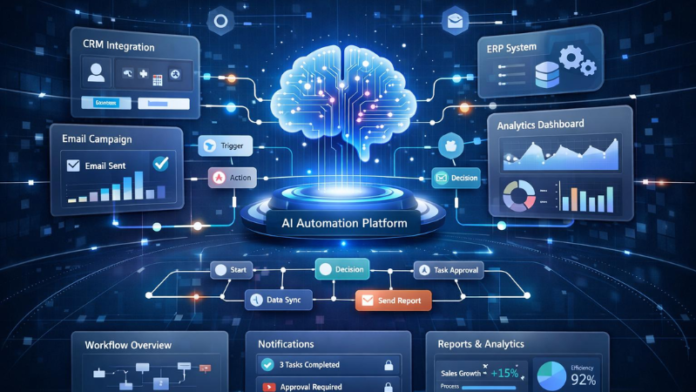
Artificial intelligence is changing the way businesses handle everyday work. At the same time, automation has already helped companies reduce repetitive tasks such as data entry, file management, and routine updates. When these two technologies are brought together, businesses can automate processes that were once too complicated for traditional automation alone.
This is where AI automation comes in. It combines artificial intelligence with automation to help systems understand information, recognise patterns, make sense of different types of data, and complete tasks with less manual involvement. For example, an AI automation system can sort documents, extract information, answer customer questions, analyse images, or support employees with business data.
AI automation provides a workable solution to increase the efficiency of current processes for businesses trying to boost output, cut down on repetitive tasks, and manage increasing workloads. However, what precisely is AI automation, how does it vary from conventional automation, and how can companies use it?
What Is AI Automation?
Businesses have been automating repetitive work for years. Simple automation can move files, copy information, send scheduled emails, and complete other tasks that follow the same steps every time.
AI automation takes that idea further.
It combines artificial intelligence with automation so systems can handle tasks that are more complicated than a fixed set of rules. Instead of only repeating the exact same action, an AI-powered system can understand information, identify patterns, classify content, respond to questions, and improve how it handles certain tasks.
For example, traditional automation might move an invoice into a particular folder whenever it is received. AI automation could go a step further by reading the invoice, identifying the type of document, extracting important information, and routing it to the appropriate team.
That combination of automation and AI is making it possible to automate a much wider range of business processes.
How Does AI Make Automation More Intelligent?
AI adds a layer of understanding to an automated process.
Instead of simply following a fixed instruction, an AI-powered automation system can:
- Understand the logic behind a task
- Analyse complex information
- Learn from available data
- Recognise patterns
- Handle different types of inputs
- Perform similar tasks across multiple situations
This makes automation more adaptable.
For example, a traditional system may only recognise a document that follows a specific format. An AI-based system can potentially identify important information even when the layout, wording, or structure changes.
What Are the Main Benefits of AI Automation?
AI automation can help businesses in several practical ways.
How Can AI Automation Improve Efficiency?
One of the biggest benefits is the ability to automate repetitive work, including tasks that are too complicated for traditional automation.
When AI handles routine processes, employees can spend more time on work that requires creativity, judgment, or problem-solving.
This can improve productivity without requiring every process to be handled manually.
How Can AI Automation Improve Decision-Making?
AI systems can analyse large amounts of information and identify patterns that may be difficult for people to spot manually.
Businesses can use this capability to support data analysis and decision-making. Automated analysis can also reduce some of the errors associated with manually processing large amounts of information.
For example, an AI system could review a large dataset, identify unusual trends, and highlight information that deserves further attention.
Can AI Automation Reduce Business Costs?
It can help reduce the amount of manual work required for certain processes while allowing businesses to handle tasks faster and at a larger scale.
This can be especially useful when demand suddenly increases. Instead of adding more manual work at the same rate, a company may use automation to handle a larger volume of tasks.
The actual savings will depend on the process, implementation costs, and how effectively the system is designed.
How Can AI Automation Support Innovation?
AI automation is flexible enough to be used across many industries and business functions.
For example, in supply chain operations, an AI system could use information from internal sensors to help adjust conditions during the transportation of goods.
Customer service is another example. AI-powered systems can respond to customer questions, work as virtual assistants, or direct users to relevant information in a knowledge base.
Which Technologies Are Used in AI Automation?
AI automation usually relies on several technologies working together rather than one single tool.
Some of the key technologies include foundation models, multimodal AI, retrieval-augmented generation, prompt engineering, and smart assistants.
What Are Foundation Models in AI Automation?
Foundation models are pre-trained AI models that learn from large amounts of data and can be adapted for different tasks.
A business can further customise a foundation model for a particular use case or connect it to internal information.
For example, a company could use its internal document library to help an AI system answer questions about company policies, products, or procedures.
Foundation models therefore provide an important foundation for many intelligent automation systems.
What Is Multimodal AI?
Traditional AI systems may focus mainly on text, but businesses often work with many different types of information.
Multimodal AI can work with inputs such as:
- Text
- Images
- Audio
- Speech
- Video
This allows businesses to automate tasks that involve more than written documents.
For example, multimodal systems can work alongside computer vision to understand images or other visual information. Optical character recognition can also help convert printed or handwritten information into machine-readable text.
That makes it possible to automate a broader range of business processes.
What Is Retrieval-Augmented Generation?
Retrieval-augmented generation, often called RAG, allows an AI model to work with information from a specific knowledge source.
Instead of retraining a foundation model every time a business needs it to understand new information, RAG can connect the model to relevant internal data.
For example, a company could connect its AI system to internal documents, product information, or knowledge bases. When someone asks a question, the system can retrieve relevant information and use it to produce a more useful response.
This can help make AI output more relevant to the organisation using it.
What Is Prompt Engineering in AI Automation?

Prompt engineering is the process of giving an AI model clear instructions so it produces the type of output a business needs.
The wording, structure, format, and details included in a prompt can influence the result.
In an AI automation workflow, well-designed prompts can help a system perform tasks more consistently and produce outputs that match the business process.
How Do Smart Assistants Support AI Automation?
Smart assistants can use company information to help automate everyday tasks.
They can connect to internal data sources, analyse information, generate content, provide summaries, and answer questions about business information.
An employee might question a smart assistant about a recent business outcome, a product specification, or a company policy, for instance. The assistant can find and display the pertinent data rather than having to manually search across several systems.
This can save employees time while making internal knowledge easier to access.
Where Can Businesses Use AI Automation?
The possible applications are broad because AI automation can work with different types of information and processes.
Some of the examples are:
- Customer service
- Document processing
- Data analysis
- Supply chain operations
- Internal knowledge management
- Image and video analysis
- Customer support
- Business research
- Administrative workflows
How Can a Business Get Started With AI Automation?
Introducing AI automation works better when a company has a clear plan rather than trying to automate everything at once.
How Should You Plan Your Automation Strategy?
Start by identifying what you want the automation to achieve.
Set clear objectives and connect them to existing business goals. At this stage, consider the budget, implementation process, expected benefits, and the specific workflows you want to improve.
A clear goal makes it easier to decide whether automation is actually solving a business problem.
Which Operating Model Should You Choose?
Businesses can organise automation work in different ways.
One option is to share automation responsibilities across development teams. This can support continuous improvement and quick feedback.
Another approach is to give automation responsibility to a dedicated team that focuses on managing business processes.
The right choice depends on the company’s size, structure, and automation needs.
Why Should Automation Be Designed End to End?
Automation should not stop at one isolated step if the wider process can also be improved.
Businesses can build automation across the development lifecycle and connect the different tools involved in the workflow.
It is also useful to monitor the security, performance, and reliability of the automation system so problems can be identified early.
How Can You Measure Whether AI Automation Is Working?
A business should measure practical results rather than simply counting how many AI tools it has deployed.
Some of the Useful measures can include:
- Cost savings
- Time savings
- Productivity improvements
- Efficiency gains
- Faster time to market
- Overall return on investment
These measurements can show whether the automation is actually creating value.
What Does Automation Maturity Mean?
Automation maturity refers to how advanced an organisation is in its use of automation.
A maturity assessment can help a business understand where it currently stands, which metrics matter most, and what it should focus on next.
As the organisation becomes more experienced, it may discover additional processes where AI automation can create value.
How Can AI Automation Support Digital Transformation?
AI automation can become an important part of digital transformation because it connects artificial intelligence with everyday business processes.
Instead of using AI as a separate tool, companies can build it into the way employees work, how information is processed, and how customers receive support.
The result can be a more connected workflow in which AI handles certain tasks while employees remain responsible for areas that require human judgment.
How Can AWS Support AI Automation?
The source highlights several AWS services that can be used to build and scale AI automation.
Amazon Q is a generative AI assistant that can help with coding, testing, debugging, business data questions, and multistep tasks.
Amazon Bedrock provides access to different foundation models through a managed service, allowing businesses to build generative AI applications.
Amazon SageMaker provides managed tools and infrastructure for building, training, and deploying machine learning models.
The source also highlights services such as Amazon Personalize, Amazon Rekognition, and Amazon Textract for recommendations, image and video analysis, and document data extraction.
These tools can be combined with other business systems to create automation workflows suited to specific needs.
What Should Businesses Consider Before Using AI Automation?
AI automation can offer real benefits, but it should be introduced with a clear purpose.
Businesses should first understand the process they want to improve, the type of data involved, the expected results, and the resources needed to implement and manage the system.
It is also important to measure whether the automation is actually saving time, reducing costs, improving productivity, or creating another meaningful business benefit.
The goal should not be to automate a process simply because AI is available. The goal should be to make the business process work better.
Conclusion
AI automation combines the repeatability of automation with the ability of artificial intelligence to understand, analyse, and work with more complex information.
Traditional automation is excellent for predictable tasks that follow the same rules. AI automation expands those capabilities by allowing systems to work with things such as language, images, documents, and large amounts of business data.
Foundation models, multimodal AI, RAG, prompt engineering, and smart assistants all contribute to this broader approach.
For businesses, the most useful starting point is usually simple: identify a process that takes too much time or manual effort, set a clear goal, measure the results, and improve the workflow over time.
When used thoughtfully, AI automation can help employees spend less time on repetitive work and more time on tasks where human skills matter most.
FAQ
What Is AI Automation?
AI automation combines artificial intelligence with automation to handle tasks that may be too complex for traditional rule-based automation. It can understand information, identify patterns, and complete tasks with less manual input.
How Does AI Automation Work?
AI automation uses AI technologies to understand information and make decisions within an automated workflow. It can classify documents, analyse data, answer questions, and perform other tasks that normally require human involvement.
What Is the Difference Between AI and Automation?
Traditional automation follows clearly defined rules and works well for repetitive tasks. AI can understand more complex information and adapt to different situations, making the two technologies useful when combined.
What Are the Benefits of AI Automation?
AI automation can improve efficiency, support better decision-making, reduce some operating costs, and help businesses handle larger workloads. It can also free employees from repetitive tasks.
Can AI Automation Reduce Business Costs?
Yes. By automating repetitive and time-consuming work, businesses may reduce manual effort and improve productivity. The actual savings depend on the process and how the automation is implemented.
How Can AI Automation Improve Decision-Making?
AI can process large amounts of data and identify patterns or trends that may be difficult to spot manually. This can give businesses more useful information when making decisions.
What Are Foundation Models in AI Automation?
Foundation models are pre-trained AI models that learn from large amounts of data and can be adapted for different tasks. Businesses can connect them with internal information for more specialised automation.
What Is Multimodal AI?
Multimodal AI can work with different types of information, including text, images, audio, speech, and video. This allows businesses to automate processes that involve more than one type of input.
What Is Retrieval-Augmented Generation in AI Automation?
Retrieval-augmented generation, or RAG, connects an AI model to relevant business information or other knowledge sources. It can help produce responses that are more useful for a specific organisation or task.
How Do Smart Assistants Help With AI Automation?
Smart assistants can connect to business data, answer questions, create summaries, generate content, and help employees complete tasks. They can make internal information easier to access without requiring manual searching.
How Can Businesses Get Started With AI Automation?
Start by identifying a specific process you want to improve and set clear goals for the automation. Then choose an implementation approach, build the workflow, and measure the results over time.
How Should Businesses Measure AI Automation Success?
Businesses can look at cost savings, time savings, productivity improvements, efficiency gains, and return on investment. These measures help show whether automation is delivering real value.
Can AI Automation Be Used Across Different Industries?
Yes. AI automation can be applied to areas such as customer service, supply chain management, document processing, data analysis, and other business workflows.
Does AI Automation Replace Employees?
AI automation is primarily used to reduce repetitive work and support employees. It can allow people to spend more time on tasks that require judgment, creativity, and other human skills.